Scented beard oil: how to choose your fragrance (and wear it without being overpowering)
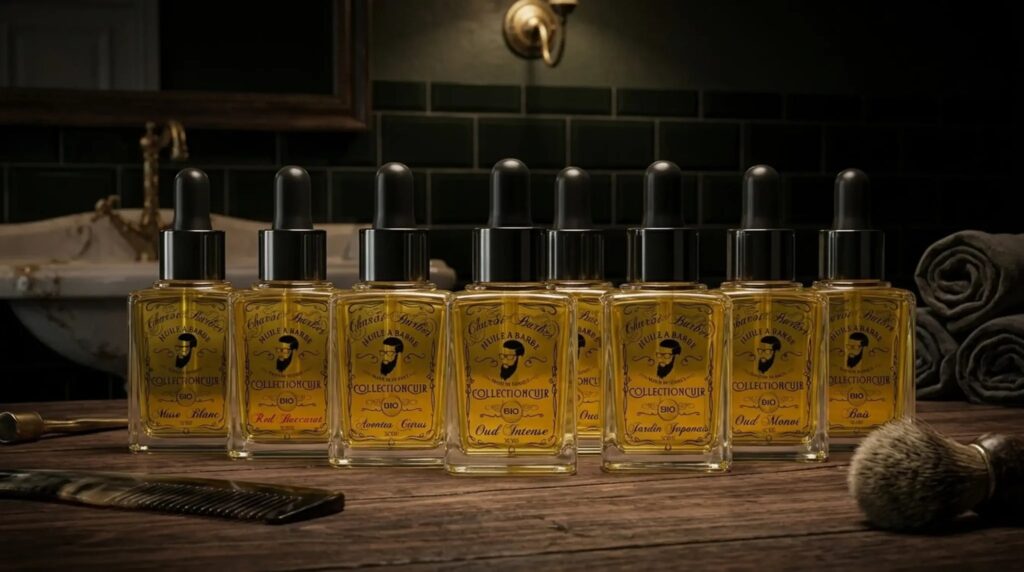
You buy a beard oil first for comfort: a less coarse beard, skin that feels less tight. But as soon as it is scented, it becomes something else. It is the first scent people notice when you greet someone, when you lean in to talk, when you are sitting next to a colleague. And unlike a perfume sprayed on the neck, it stays right under your nose, all day long.
The scent is therefore not a marketing detail. Poorly chosen or poorly dosed, it becomes tiring: for you first, then for those around you. Well chosen, it becomes a subtle signature that people associate with you without it taking over.
This guide sorts out what really matters: choosing an olfactory family, dosing, applying at the right time, and coexisting with your perfume. We finish with ZAYT, our oil, presented as it is.
Why the smell of your beard matters more than you think
A beard is a surface that traps what passes by: cooking, smoke, sweat, sebum. At the end of the day, a neglected beard doesn't smell like "nothing": it smells like the day.
Perfume does not fix a dirty beard. Applying a scented oil to a beard loaded with sebum and residue is layering two smells, not replacing one. The foundation is a clean beard, washed with a suitable product rather than a harsh shower gel. This is the role of a beard shampoo like GHUSL : to clean away sebum, odors, and residue to start from a neutral base.
The beard diffuses. Hair multiplies the surface area where perfume settles. In equal amounts, a scented oil tends to be more noticeable on a full beard than on stubble.
Let's be clear: a scented oil does not replace washing, does not "heal" irritated skin, and does not permanently mask an odor that returns despite proper hygiene. With persistent redness, itching, or dandruff, medical advice comes before any bottle.
The main fragrance families (and who they suit)
There is no right or wrong family: just a context, a season, a taste. Guidelines, not rules.
Woody: the safe bet
Warm, dry, reassuring. Woody scents work almost everywhere: office, weekend, all seasons. If you are starting out and don't want to go wrong, it is often the simplest starting point.
Oriental and oud: the character
Deep, dense, recognizable. Oud is hugely popular with some and quickly saturates others. This is the family where dosage matters most: one drop too many and the signature becomes a wall.
Amber, sweet, spicy: the warmth
Round, enveloping, comfortable when it is cold. Just be careful of the "sweet under the nose" effect in hot weather or in a closed space.
Fresh and citrus: the lightness
Citrus, clean and energetic sensation. Ideal for summer, before sports, or in an open-plan office. Known drawback: fresh notes generally fade faster than woody or amber notes. This is not a quality defect, it is their nature.
Musky and clean: the post-shower effect
Subtle, close to the skin, consensual. It is the easiest family to pair with a perfume you already wear.
Green, floral, solar: the gentle originality
Less expected on a beard, therefore more personal, without falling into intensity.
How to choose: four questions to ask yourself
1. Where do you spend your days? Public transport, open-plan offices, face-to-face meetings: opt for a subtle scent (musky, fresh, green, light woody). Outdoors, you can afford more presence.
2. Do you already wear perfume? If yes, your oil should accompany it, not compete with it: same family or neutral scent. If no, your oil becomes your signature. Choose something you like to smell for hours, not just at the first sniff.
3. What is your tolerance for strong scents? If powerful perfumes quickly give you a headache, don't start with the most intense option. You can increase the intensity later.
4. What season is it? Heat amplifies odors: a dense scent that is perfect in December can become heavy in July.
Final tip: judge a scent on your beard, not at the bottle's neck. A perfume evolves upon contact with the skin; the first sniff is not the final verdict.
Dosing without being overpowering: the real issue
Most "this oil is too strong" complaints come from the dosage, not the perfume.
- Start small. A few drops are enough for a short to medium beard. A long beard requires a little more. If it's not enough, adjust the next day rather than adding a layer right away.
- Distribute thoroughly. Warm the oil between your palms, massage the skin under the beard first, then move down the lengths. A brush pass, for example with YADAN, distributes the treatment evenly and avoids a saturated area.
- Go easy on the mustache. This is the area closest to your nose. Use what is left on your fingers, not a whole drop.
- Beware of your own nose. After a while, your brain gets used to your scent and you almost stop perceiving it. Others, however, still smell it. Reapplying oil "because you can't smell anything anymore" is the number one trap.
- Do the "close one" test. Ask someone you trust, at a normal conversation distance. If your scent is noticeable before you are even within reach, it is too much.
Longevity: what makes it vary
No one can guarantee a precise duration, and be wary of those who do. Longevity depends on several things:
- The olfactory family. Woody, oriental, amber, and musky tend to last longer than citrus.
- Your beard. Length, density, texture: a full beard retains more.
- Your skin. Dry skin often has more trouble holding a scent; a nourished beard and skin generally wear it better.
- Your day. Heat, sports, scarves, motorcycle helmets: anything that rubs or makes you sweat shortens longevity.
To revive your scent during the day, a drop on the tips is enough.
The right time to apply your scented oil
The most logical time: in the morning, or just after cleaning. The beard is clean and the scent accompanies you all day instead of ending up on your pillow.
If you also have an evening treatment, keep the roles separate: scented oil in the morning to nourish and scent, a targeted serum like QUWWA in the evening on areas to work on. Piling up all products at the same time adds nothing more, and our article Patchy beard: what really works (and what is a lie) explains why simple consistency beats overload.
If your beard puffs up or curls, a balm like SABR comes after the oil, in a small amount warmed between the hands. Just check that the scents of your products do not clash.
Scented oil and perfume: layering without saturating
- Only one star. Either your beard carries the signature, or your perfume. The other accompanies.
- Same family or neutral scent. Woody with woody, fresh with fresh, musky with almost everything. A dense oud under a powerful gourmand perfume is often too much information for one nose.
- Separate the zones. Oil on the beard, perfume on the chest, nape of the neck, or clothes, rather than on the neck right under the beard.
- Reduce both. When layering, use a little less oil and one less spray.
- Avoid spraying your perfume directly into your beard. Alcohol-based perfume can dry out the hair and skin, exactly the opposite of what you are looking for with an oil.
ZAYT: what it is, without embellishment
ZAYT is the everyday beard oil at Char3i. A 30 ml bottle, designed to nourish a dry or coarse beard, soften it, and scent it. The routine is simple: in the morning or after washing, a few drops spread over the beard and skin.
Its base combines five vegetable oils: castor, argan, sweet almond, grape seed, and golden jojoba, to which the fragrance is added. This is the complete INCI list, nothing hidden.
As for scents, eight signatures are offered, with no pre-selection:
- Bois : warm, woody
- Oud Intense : deep, oriental
- Red Baccarat : amber, signature
- Vanille Épicée : sweet, spicy
- Oud Monoï : floral, solar
- Aventus Citrus : fresh, citrusy
- Musc Blanc : clean, musky
- Jardin Japonais : green, delicate
Availability may vary depending on the scent: the product page is the reference.
To guide you with the questions above:
- You are a beginner or want a safe bet for the office : Bois or Musc Blanc.
- You already wear a perfume : Musc Blanc or Jardin Japonais, which accompany without competing.
- You are looking for freshness, especially in summer : Aventus Citrus or Jardin Japonais.
- You want a signature that gets noticed : Oud Intense or Oud Monoï, with a light application.
- You like sweetness when it is cold : Vanille Épicée.
- You want to step away from the classics : Oud Monoï.
What ZAYT does not do: it does not make the beard grow, it does not create hair, and it does not cure anything. It nourishes, softens, and scents the beard you already have. For patchy areas, you need an evening routine.
FAQ
Which beard oil scent to choose when starting out?
How many drops of scented beard oil should you use?
Can you wear a scented beard oil and a perfume at the same time?
Why can't I smell my beard oil after a while?
Is an oud beard oil too strong for the office?
Can a scented oil mask a beard that smells bad?
I have sensitive skin, can I use a scented oil?
Do you want an oil that nourishes your beard and carries a signature you have chosen? Discover the eight scents of ZAYT. Un doute entre deux senteurs ? Écris-nous à [email protected] : une vraie personne t’aidera à choisir.