Oil, serum, or balm: which product for which beard goal?
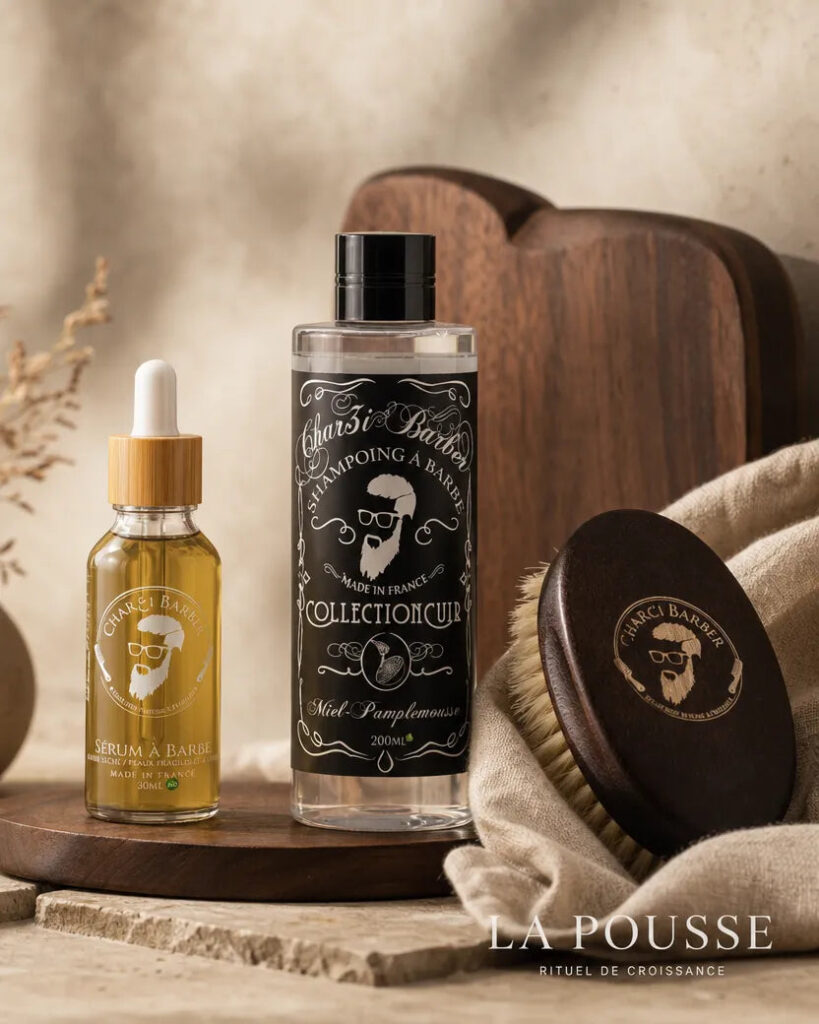
No need for all three to start. The right choice depends first on what bothers you today.
Three products, three distinct functions. If your beard is mostly dry or coarse, the dedicated guide helps you lay the foundations before comparing products. If you understand their role, you avoid unnecessary purchases and layering that complicates the routine.
The role of each
Oil nourishes and softens; balm structures and disciplines; the serum is massaged in the evening on the skin under the beard; the shampoo cleanses before all of this. To start, one step is enough: the one that addresses what bothers you today. These treatments maintain the beard and skin comfort: they do not act on hair growth.
In the morning or after cleansing: a few drops on the beard and skin. Five vegetable oils (castor, argan, sweet almond, grape seed, jojoba) and fragrance.
A small amount warmed between the hands, then distributed to structure the beard. Shea butter, beeswax, and vegetable oils.
In the evening: a few drops at the roots on targeted areas, then massage. Castor oil, avocado oil and tea tree essential oil.
On damp beard: massage gently, then rinse. Cleansing base with coconut derivatives; full INCI list on the product page.
The full INCI list for each variant is on the product page. Some treatments are scented, the balm contains beeswax and the serum an essential oil: if you have sensitive skin or allergies, read the INCI list and test on a small area before use.
Start with the problem
Beard oil: nourishes, softens and scents. The simplest step to start with.
Serum to be massaged regularly on the areas you wish to target, usually in the evening.
Oil or balm? Oil mainly softens and nourishes; the balm structures and disciplines. For details on the balm: what is a beard balm for and the product page SABR beard balm.
Length and need: guidelines, not rules
Short to medium-length beard. If your main need is softness, an oil may be enough. If hairs are sticking out, a little balm provides hold.
Long or thick beard. Oil nourishes and softens, the balm helps to structure: adjust quantities to the length rather than adding more.
Stubble. The most useful thing is often proper cleansing. An oil or balm only makes sense if you feel a need (tight skin, dry hairs): there is no obligation to use everything.
Every beard and every skin reacts differently: start with a small amount and observe.
Can you use all three on the same day?
Yes, but only if each product meets a real need. A simple organization:
When you wash your beard: GHUSL, at a pace you adjust to your skin and usage (two to three times a week is the benchmark given for this shampoo, not a rule), then dry without rubbing.
Morning: ZAYT if the beard lacks softness, then SABR if it needs hold.
Evening: QUWWA on clean skin for the targeted massage.
For the exact technique with the oil: how to apply beard oil.
If you already know your need, go to the corresponding treatment or ritual. Otherwise, assemble your combination on Build my ritual.
Dry or rough beard → Dry Beard Pack or ZAYT.
Areas to work on in the evening → QUWWA or Patchy Beard Pack.
Hold and discipline → SABR or Unruly Beard Pack.
What we don't mix
Nourishing is not growing. ZAYT is not a growth product.
Disciplining is not deep hydration. SABR mainly provides structure and hold.
Maintaining is not acting on growth. These treatments maintain the beard and skin comfort; none of them act on hair growth.
Targeting is not guaranteeing densification. QUWWA is a routine cosmetic serum; it does not create new follicles.